

As part of its educational and scientific-outreach activities, the Faculty of Medicine held a practical seminar on October 1, 2026, titled "STI Preven
Quotation gallery
In every case, the remedy is to take action. Get clear about exactly what it is that you need to learn and exactly what you need to do to learn it.
Miguel de Cervantes
Faculty’s news
29 сентября — Всемирный день сердца! В честь этой даты медицинский факультет совместно с психологической службой университета организовал информацион
To foster social and educational engagement, promote medical science, and spark student interest in medical research and knowledge, the "Med-Quiz" bli
29 сентября 2026 года со студентами групп 2 мед 26-1 и 2 мед 26-2 проведён куратором Шилкиной Ольгой Ивановной экологический час на тему «Экология нач
28 сентября 2026 г. состоялся творческий вечер «Мир книг: читаем, обсуждаем, открываем» среди студентов специальности «Фармация». Творческий вечер пр
25 сентября 2026 года со студентами групп ОМ 26-2к, ОМ 26-3 медицинского факультета состоялся круглый стол на тему «Конституция — основа стабильности
16 сентября для студентов медицинского факультета в рамках эдвайзерского часа было проведено мероприятие на тему «Закон и порядок — основа безопасного
The Faculty of History, Economics, and Law hosted a scholarly roundtable titled "Northern Kazakhstan within the Steppe Communication Network of the
The Faculty of History, Economics, and Law hosted a scholarly roundtable titled "Northern Kazakhstan within the Steppe Communication Network of the Go
Проведён семинар по академической политике вуза с участием студентов групп Мед 3-26. В ходе мероприятия обучающиеся ознакомились с основными положения
Development of a Neural Network Model for UAV Recognition through an Optical-Electronic Channel Integrated into the Data Fusion System
This research is funded by the Science Committee of the Ministry of Science and Higher Education of the Republic of Kazakhstan (grant No. AR19679009).
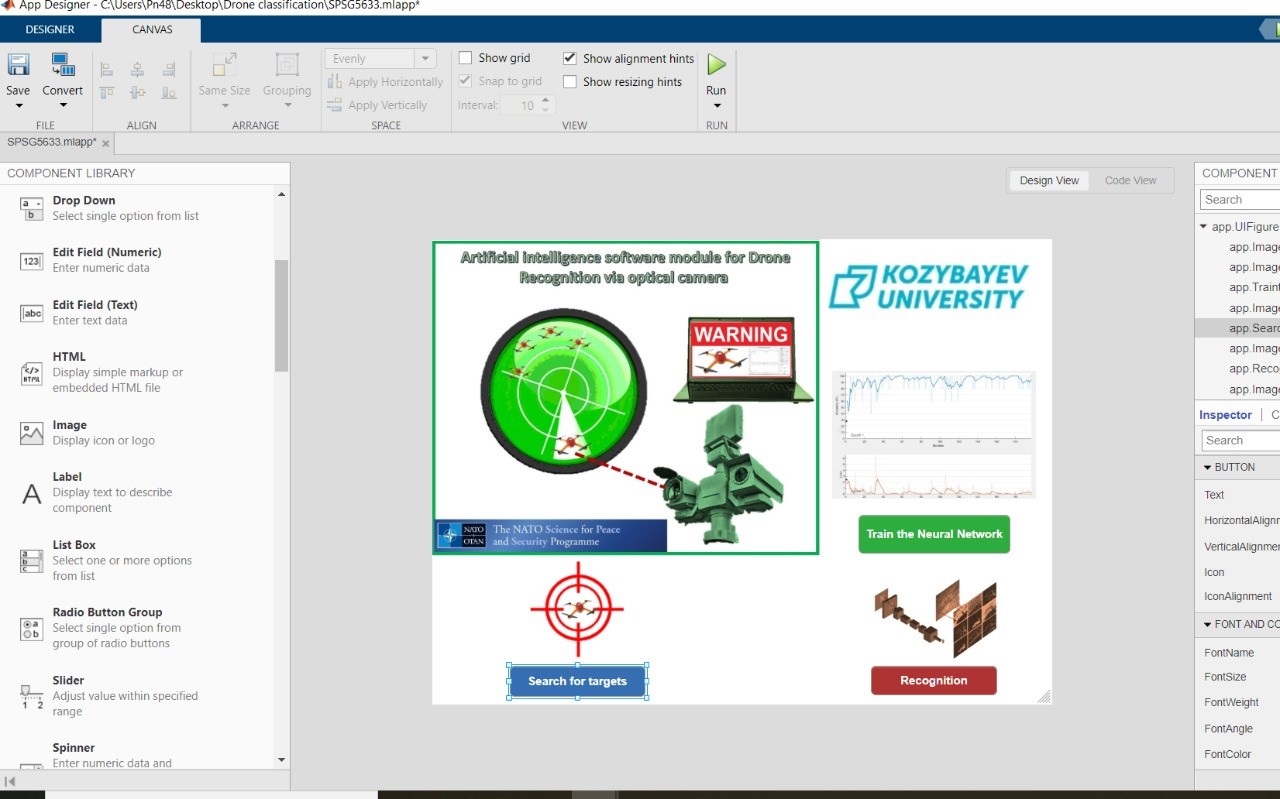

Project Manager: Kurmashev I.G., Candidate of Technical Sciences.
Project Performers: Kurmashev I.G., Candidate of Technical Sciences, Serbin Vasily Valeryevich, Candidate of Technical Sciences, Arrichiello Filippo, Doctor of Technical Sciences, Semenyuk V.V., Master, Alyoshin D.V., Master, Kryuchkov V.N., Master, Kurmasheva L.B., Master.
Implementation period: 2023 – 2025.
Project goal: To develop a software model for UAV recognition based on neural networks, adapted to the "FMCW radar + video surveillance" platform, performing high-quality and highly accurate recognition, classification, and differentiation of these objects from birds by analyzing the optical channel and micro-Doppler characteristics of the target. Expected outcomes: Development of a software model for UAV recognition based on algorithms of two types of neural networks, adapted to the optical and radar channel of the "FMCW radar + video surveillance" system. Project description: The project idea is to create a neural network software model, one part of which is designed for UAV recognition through radar imaging of micro-Doppler signatures, ensuring more accurate classification of drones and birds. The second segment of the software model defines a neural network application for UAV recognition through video data and photo images of objects in the airspace (quadcopters, "flying wing" UAVs, birds, etc.). The unique feature of this development lies in its adaptation to an Anti-Drone radar system with a software-hardware platform based on "Radar + Optical Channel" as an automation element for UAV recognition using two detection channels. The performance and effectiveness of the developed software model depend on the characteristics of the radar system and optical camera, making the selection and justification of the radar model and surveillance tool a key task. Additionally, the project will present the mathematical characteristics of radar signal reflection from targets with vibration sources, determining Doppler indicators for recognizing flying objects (UAVs and birds). The structural description of the Data Fusion system, into which the developed software model is integrated, along with the characteristics of the neural network algorithms serving as the basis for classification and recognition software within the research framework, will also be provided.